
It was a dark and stormy night! The Arrival of Greta
To make the Green Saga stories credible, we will give readers elements they can relate to. The narratives will be inspired by reality and by the people around us, enriching the plot with events from the past but also from the present. Sometimes it takes no more than leafing through a magazine or doing a quick search online to find an event or a figure whose life and actions are truly exemplary. Some stories are so remarkable that, if we did not know they were real, we might imagine they had been written by an excellent writer.
Greta Thunberg is a person who can represent the perfect example, far from every stereotype and cliché, which often sees heroes as male, adult, and without “defects.”
Greta is a woman, although when she began to deal with climate issues, she was really very young, she was only eight years old! Greta is on the autism spectrum, which in the eyes of many makes her different, but she believes that, thanks to this, she manages to see things clearly. For her, the question of climate is simply very clear: action must be taken. Greta was born in Stockholm in 2003. At eight years old, hearing talk about climate change, she decided to go on a hunger strike, deciding shortly afterwards to become vegan. At fifteen (2018), she was able to create a movement, #FridaysforFuture, that involved people all over the world.
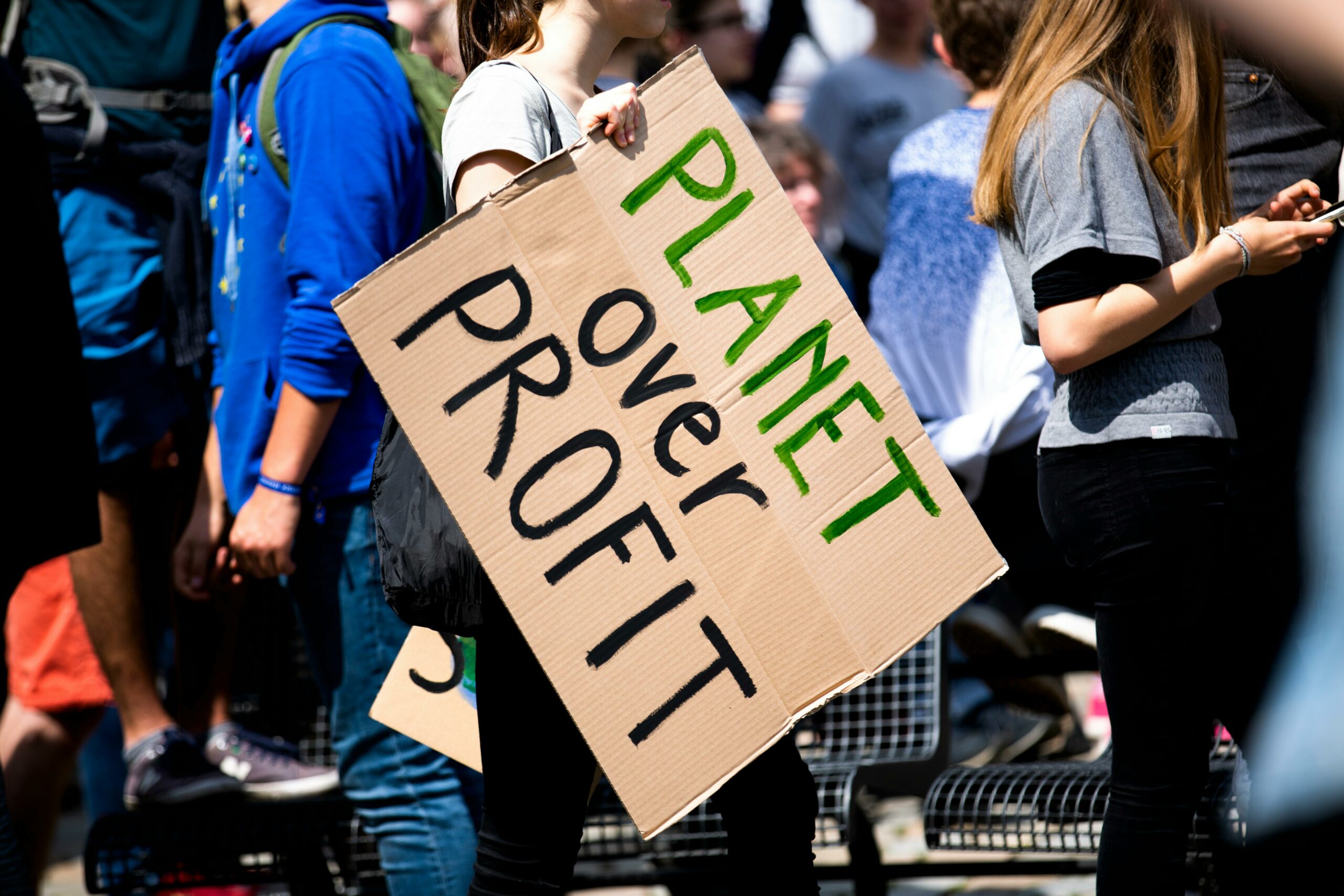
Every Friday, instead of going into class, she sat outside the Swedish Parliament to protest against climate change, managing to make people understand how serious and worrying the situation is. The movement became global and attracted young people and very young people, but also those adults who until then had never been interested in climate.
Small, blonde, two little braids framing her face on which stood out a serious and resolute look. Alone with a handwritten sign, she sat for weeks outside school to tell adults that the future, the future of everyone, but above all of those like her who “have a whole life ahead of them”, was at risk of disappearing, as the problems caused by climate change seemed to outpace the future itself.
“How can I go to school to improve my future if my future is at risk!” Isn’t she right? Isn’t it the case? “What is the use of studying to prepare for the future if that future is already so compromised?” But Greta, with her initially solitary action, showed us the way: each one of us, with our own actions, can make a difference and give our contribution; every single action can make a difference.
Millions of teenagers began to join her, as did adults, parents interested in their children and in the world they are leaving behind. One year after the beginning of the Fridays of protest, the sales of children’s and young adult books with environmental themes had doubled, as had donations to associations that deal with climate change.
But Greta did not stop. Despite her young age, she met world leaders to remind them that there is an agreement, the Paris Agreement, and that everyone is obliged to respect it. Her speech at the United Nations COP24, in Katowice, Poland, was a direct attack against the apathy and lack of foresight of politicians, who limit themselves to speaking without ever transforming those words into concrete actions.
In 2019, she met Barack Obama, and in New York, she participated in the largest demonstration, walking alongside 4 million people to protest against climate change. In September of that same year, she participated in the Climate Summit of the United Nations General Assembly, delivering an even more significant speech:
“You come to us young people for hope. How dare you? You have stolen my dreams, and my childhood, with your empty words. And yet I am one of the fortunate ones. People are suffering, people are dying. We are in the beginning of a mass extinction and all you can talk about is money and fairytales of eternal economic growth. How dare you? For more than 30 years, the science has been clear, crystal clear. How dare you continue to look way?”
Greta received a nomination for the Nobel Peace Prize, which then went to the Ethiopian Prime Minister… nevertheless becoming, according to “Time”, Person of the Year!
Her story reminds us that each of us has the power to drive change, and that true happiness cannot be found by thinking only of ourselves.
However, if we imagine her simply as the character of one of our stories, here paths and variables open up, as well as stimuli and suggestions for writing, because truly in her, there are all the ingredients that our gamebooks need: a strong environmental and social conscience, the idea of sustainability as a possible and inclusive happiness, the capacity to make mature and responsible choices such as when she crossed the ocean by boat rather than take the airplane!
And it is news of only a few days ago that sees her now a young adult, at the head of 200 activists from Extinction Rebellion, against the largest oil refinery in Mongstad, Bergen, on Norway’s southwestern coast. Norway is one of the biggest producers of gas and oil, Equinor is a giant that intends to maintain production at a fast pace at least until 2035. “Fossil fuels bring death and destruction!” Greta declared, asking instead to eliminate the use of fossil fuels… a cue for a story? But above all, for a reflection and a shared commitment so that there may still be a possible future!
Bibliography
Thunberg, G. (2019). Nessuno è troppo piccolo per fare la differenza (No one is too small to make a difference). Milano: Mondadori.
Thunberg, G. (2019). La nostra casa è in fiamme. La nostra battaglia contro il cambiamento climatico (Our house is on fire: Our fight against climate change). Milano: Mondadori.
Camerini, V. (2019). La storia di Greta. Non sei troppo piccolo per fare cose grandi. La biografia non ufficiale di Greta Thunberg (The story of Greta: You are never too small to make a difference. The unofficial biography of Greta Thunberg). Milano: De Agostini.
Thunberg, G. (2022). The climate book (Italian edition). Milano: Mondadori.